GEOMETRIC CONSTRUCTION - A Beautiful Greek Antiquity:
(
From Weisstein, Eric W. "Geometric Construction." From MathWorld--A Wolfram Web Resource.)
In antiquity, geometric constructions of figures and lengths were restricted to the use of only a straightedge and compass (or in Plato's case, a compass only; a technique now called a
Mascheroni construction). Although the term "ruler" is sometimes used instead of "straightedge," the Greek prescription prohibited markings that could be used to make measurements. Furthermore, the "compass" could not even be used to mark off distances by setting it and then "walking" it along, so the compass had to be considered to automatically collapse when not in the process of drawing a circle.
Because of the prominent place Greek geometric constructions held in Euclid's Elements, these constructions are sometimes also known as Euclidean constructions. Such constructions lay at the heart of the geometric problems of antiquity of circle squaring, cube duplication, and angle trisection. The Greeks were unable to solve these problems, but it was not until hundreds of years later that the problems were proved to be actually impossible under the limitations imposed. (Also see
Compass and straightedge constructions)
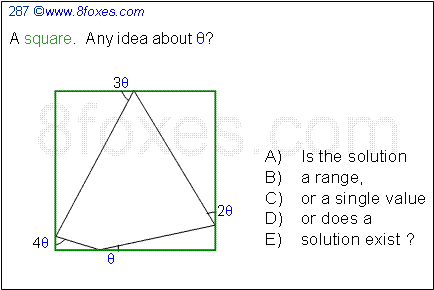
 This is our first geometric construction problem, based on a solution submitted by Bleaug. We have a few other construction problems in the queue. For those who are new: the question asks to draw triangle PQR in any equilateral triangle by using a compass, a ruler (without any numbers on it), and angle α (and a piece of paper too :) Let us know if you have any questions!
http://www.8foxes.com/
 http://www.8foxes.com/

 This is our first geometric construction problem, based on a solution submitted by Bleaug. We have a few other construction problems in the queue. For those who are new: the question asks to draw triangle PQR in any equilateral triangle by using a compass, a ruler (without any numbers on it), and angle α (and a piece of paper too :) Let us know if you have any questions!


