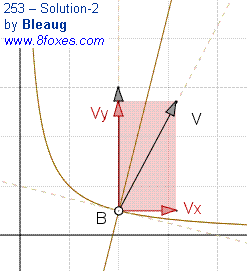
A 2-circle covering problem would have been easier. But Let's start with this one.

 http://www.8foxes.com/
Two flow together
one rises one falls
one after another
one shines one glooms

Migue:
If area is A the answer is f(x)=y=A/2x.
f(x) is the envelope of all straight lines that close in with axes X-Y constant area equals to A.
Equation of one of this lines is: x/a + y/b = 1 (a,0) in X & (0,b) in Y.
Notice that a & b are two variable parameters.Another equation is: ab/2 = A (area of triangle that straight line draws with axes).
(1) Let f(x,y,a,b)= bx+ay-ab = 0
(2) Let g(a,b)=ab-2A = 0
(3) f'a · g'b - f'b · g'a = 0 (Jacobian of derivatives respect to a and b parameters).
f'a is the derivative of f respect a, ...
y/b - x/a = 0 (3)
If we resolve this system of equations (1),(2) & (3) we obtain:
a = 2x & b = 2y -> ab = 4xy = 2A -> xy = A/2 (equilateral hyperbola)
and y = f(x) = A/2x.
Answer is D) for A =1.

This means that the point M we are looking for is such that M is midpoint of AB and AB tangent in M. This brings us to problem 260 where we already encountered point V(4/3, 8/9):
- tangent in V is parallel to UP and vector(UP) = vector(VB) because of parabola property (see Fox 260)
- vector(UP) is symmetric of vector(VO) along y axis because of parabola symmetry
- thus OVB is isoceles and V is the midpoint of AB

Thus V achieves minimal OAB area.
Area = 4/3 . 16/9 = 64/27.
By Yu:
 Equation of tangent at x=a, y=-(2a-2)x+a^2.
Area of triangle = (a^4)/(4(a-1)).
When a=4/3, minimum area = 64/27. Question: a=4/3 in Fox 260 and Fox 262. Is this a coincidence?

Then let's assume U and V achieve the maximum trapezoid area between A (x=0) and B(x=2), then necessarily Au=uv and uv=vB which implies Au=uv=vB=AB/3=2/3. Because of symmetry, maximum area is equivalent to area of rectangle AvVW = 8/9 * 4/3 = 32/27.
Geometric Translation
by Yu
Translate y=2x-x^2 to the left by 1 unit to obtain y=1-x^2.

Without going into details, the area of the trapezium is greater than the area of the quadrilateral. Area of trapezium, A = (1/2) (2x+2)(1-x^2) = (x+1)(1-x^2)
Max A = 32/27 when x = 1/3.
For more details see Fox 260.
http://www.8foxes.com/