Showing posts with label Motion on earth. Show all posts

Thursday, February 10, 2011

Fox 15 - Solution

Well, we haven't received any comments. So here is the animated solution for Fox 15 by Bleaug.

"... Not an easy one though. I have tried to provide an animated SVG solution because packing all info into one single drawing or comment text would become clumsy. The proof is based on well-known (?) geometric properties of parabolas..."

To see the animation below, you will need any of the following browsers:
Chrome, Firefox, Opera, Safari, or IE Explorer 9.0.


Use mouse clicks or left-right arrows on your keyboard to browse thru the pictures.

Sunday, January 9, 2011

Fox 15

This ancient fox was the general case of Fox 187, which was successfully-solved. And now, Bleaug claims that this has been solved, too. Let's see if we'll be able to confirm his claim.

Sunday, December 19, 2010

Year-End Note

It is that time of the year again.

We heard a call from South,

saying, "Come - whoever you are!"
"Poor or rich"
"Full or null"
"Up or down"
"Live or dull"
"Come, just hear my cry!"

It was not the ears heard the call,
But the heart trembled with it.
How can one remain unconscious to this call?

So my friend,
never reject a good call.
Shine with your mercy
upon everyone.

Break your daily routine,

Do things out of the box.

Search the good in bad,
And never give up thinking.

--- Polar Fox

Friday, April 16, 2010

Fox 272 - Solution


Yu claims the following:
Without the parabolic track a particle (initially at rest) at the vertex will be in free fall and drops at maximum acceleration of g. With the parabolic track the motion is restricted by the track and the particle is no longer in free fall; it slides down the track with increasing speed. Will it leave the track at some point?

All parabolic tracks are similar (See Fox 270). Consider the track y=-x^2 which ends at the point (x,-x^2).


When a particle slides from rest at the vertex (0,0) to the point (x,-x^2), it acquires speed v=sqrt(2gx) in the direction given by tanθ=dy/dx=-2x, where θ is the angle with the x-axis.
.: cosθ = 1/sqrt(1+4x^2), sinθ=-2/sqrt(1+4x^2).


At point (x,-x^2) the particle is in free fall,
v_H=sqrt(2gx)/sqrt(1+4x^2),
v_y=-2sqrt(2gx^2)/sqrt(1+4x^2).


After a further time Δt, Δx=sqrt(2gx)Δt/sqrt(1+4x^2),
Δy=-2sqrt(2gx^2)Δt/sqrt(1+4x^2) - (1/2)g(Δt)^2
= -2xΔx-(1+(1/4x^2))(Δx)^2,
and the particle is at y=-x^2 - 2xΔx -(1+(1/4x^2))(Δx)^2.


If the track did not end at (x,-x^2) but continued to infinity,
y=-(x+Δx)^2
= -x^2-2xΔx-(Δx)^2 > -x^2 - 2xΔx -(1+(1/4x^2))(Δx)^2.
.: The particle stays on the parabolic track.

Monday, April 5, 2010

Fox 272

The claim assumes that there is a positive gravity in the given direction.
So, it should hold in Pluto as well.


Himalayan fox: Here is a claim ready to be blown away with a single counterexample. How strong is your theory Polar?
Polar fox: Well, I can smell it.
Himalayan fox: It demands more than that. Are you living in a paper castle ready to be drifted away by the next wind? Or are you a real believer of something that even the strongest quake can not shake you a bit - you stand firmly on the ground?
Polar fox: No problem on my stand man! I am not shaken at all, but... the thing is... the ice is melting!

Sunday, February 28, 2010

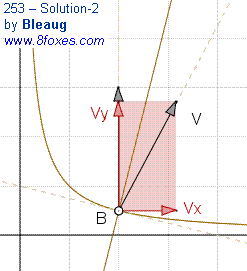
Fox 253 Solution


Bleaug goes on:

Energy acquired in free fall from rest position is 1/2.mV2=mg(h0-1/2)

Vertical velocity after bounce is V reduced by a factor equal to cos(2a), where a is the angle of tangent to 1/x at B: Vy = V.cos(2a) and tan(a)=-1/4

Highest point reached after bounce is such that: 1/2.mVy2=mg(h-1/2), so h = 1/2 + cos(2a)2.(h0-1/2)

From simple trigonometry we get cos(2a) = 1-tan(a)2/(1+tan(a)2) = 15/17

So h = 1/2 + (15/17)2 . (h0-1/2) = 1/2 + (225/289). 289/2 = 113.

Tuesday, November 24, 2009

Tuesday, November 17, 2009