Showing posts with label Formula of a parabola. Show all posts

Friday, April 16, 2010

Fox 272 - Solution


Yu claims the following:
Without the parabolic track a particle (initially at rest) at the vertex will be in free fall and drops at maximum acceleration of g. With the parabolic track the motion is restricted by the track and the particle is no longer in free fall; it slides down the track with increasing speed. Will it leave the track at some point?

All parabolic tracks are similar (See Fox 270). Consider the track y=-x^2 which ends at the point (x,-x^2).


When a particle slides from rest at the vertex (0,0) to the point (x,-x^2), it acquires speed v=sqrt(2gx) in the direction given by tanθ=dy/dx=-2x, where θ is the angle with the x-axis.
.: cosθ = 1/sqrt(1+4x^2), sinθ=-2/sqrt(1+4x^2).


At point (x,-x^2) the particle is in free fall,
v_H=sqrt(2gx)/sqrt(1+4x^2),
v_y=-2sqrt(2gx^2)/sqrt(1+4x^2).


After a further time Δt, Δx=sqrt(2gx)Δt/sqrt(1+4x^2),
Δy=-2sqrt(2gx^2)Δt/sqrt(1+4x^2) - (1/2)g(Δt)^2
= -2xΔx-(1+(1/4x^2))(Δx)^2,
and the particle is at y=-x^2 - 2xΔx -(1+(1/4x^2))(Δx)^2.


If the track did not end at (x,-x^2) but continued to infinity,
y=-(x+Δx)^2
= -x^2-2xΔx-(Δx)^2 > -x^2 - 2xΔx -(1+(1/4x^2))(Δx)^2.
.: The particle stays on the parabolic track.

Sunday, April 11, 2010

Fox 271 - Solutions

Two solutions for Fox 271.
Geometric Solution by Bleaug:

Couldn't resist a geometric approach to this one despite the obvious analytical solution...
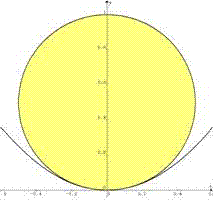
We are looking for the osculating circle to the parabola in O. This circle is such that for M approaching O, normal in M crosses normal in O (y axis) at osculating circle's center.
Take the [y=x^2] parabola focal point F(0, 0.25). For any point M, the normal crosses the y axis in P such that FP=FM (because all blue angles are equal). Thus, the tangent in M crosses the y axis in Q such that FM=FQ=FP.
When M approaches O, so does Q so FP=FO. So osculating circle to parabola in O is such that OP=0.5 (diameter=1)

Analytic Geometry by Yu (similar submitted by Joe, Bob Ryden and Newzad):
Let r be the radius of the biggest circle that touches the parabola.
x^2 + (y-r)^2 = r^2, y=x^2. Point(s) of contact:
(0,0), ±(√(2r-1), 2r-1).
Same gradient at point(s) of contact: .: dy/dx = -(x/(y-r)) = 2x, i.e., at x=0 or y=r-(1/2).
.: 2r-1=r-(1/2), r=1/2. Hence there is only one point of contact (0,0), and the biggest circle has a diameter of 1.

http://www.8foxes.com/

Monday, April 5, 2010

Fox 272

The claim assumes that there is a positive gravity in the given direction.
So, it should hold in Pluto as well.


Himalayan fox: Here is a claim ready to be blown away with a single counterexample. How strong is your theory Polar?
Polar fox: Well, I can smell it.
Himalayan fox: It demands more than that. Are you living in a paper castle ready to be drifted away by the next wind? Or are you a real believer of something that even the strongest quake can not shake you a bit - you stand firmly on the ground?
Polar fox: No problem on my stand man! I am not shaken at all, but... the thing is... the ice is melting!

Thursday, March 18, 2010

Fox 260 - Solutions

Almost Pure Geometric Solution (An Essential Property of a Parabola)
by Bleaug

Let's take as a parabola "well known" property that for any two points U, V of abscissa u, v, the tangent to point T of abscissa (u+v)/2 is parallel to vector UV. (OK! this demonstration would need some cartesian algebra but simple, promise!) From this we derive that for any point M between U and V the area of triangle UMV et less or equal to area of triangle ATV which maximizes triangle height (e.g. assume the opposite and compare area of triangle obtained from M+dM)

Then let's assume U and V achieve the maximum trapezoid area between A (x=0) and B(x=2), then necessarily Au=uv and uv=vB which implies Au=uv=vB=AB/3=2/3. Because of symmetry, maximum area is equivalent to area of rectangle AvVW = 8/9 * 4/3 = 32/27.

Geometric Translation
by Yu

Translate y=2x-x^2 to the left by 1 unit to obtain y=1-x^2.


Without going into details, the area of the trapezium is greater than the area of the quadrilateral. Area of trapezium, A = (1/2) (2x+2)(1-x^2) = (x+1)(1-x^2)
Max A = 32/27 when x = 1/3.

For more details see Fox 260.
http://www.8foxes.com/

Tuesday, November 17, 2009