 Won't you come and see?
Some fly away,
some remain lonely.
-- Himalayan Fox

Fox 325 by six:
Fox 326 by Bob Ryden:
Fox 326 by Binary:
Fox 328 by César Lozada:
Fox 328 by Bob Ryden:

 Semi-major axis: (1/2)(√3 + cot(α/2))
Small Ellipse

 Ratio of their areas (large : small) = (1 + √3 cotα)/(1 - √3 cotα)
Scalar values u=OU and v=OV vary according to a quadratic equation (e.g. apply cosine rule to OUV triangle)
M is a linear function of U and V, hence M coordinates obey some quadratic equation, i.e. M location is a conic. Same applies to N.
Since UV=1, these conics are finite, hence they are ellipses.
Since construction is symmetric, these ellipses are centered in O and have OUV bissectors as symmetry axes.
267: From Fox 266 we know that ON=UN=UV=1, hence N location is a circle of radius 1 centered in O.
268: The skew transform into green ellipse preserves the area. So blue/green ellipse area is twice the red circle area = 2*pi.
Yu: (267)
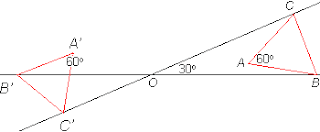
m(BOC) = (½) m(BAC), .: O, B and C are on the circle centred at A, .: OA = AB.
m(B'OC') = (½) m(B'AC'), .: O, B' and C' are on the circle centred at A', .: OA' = A'B'.
AB = A'B', .: OA' = OA. For other orientations refer to Fox 266.
The vertex A is always the same distance from O, so it maps out a circle of radius OA centred at O.
Yu: (268)
 The two intersecting lines are y = ±(2 - sqrt(3))x.
Let A(a, (2-sqrt(3))a) and B(b, -(2-sqrt(3))b).
AB^2 = (2-sqrt(3))^2 (a+b)^2 + (a-b)^2 = 1.
By matrix methods, vertex C has x=(sqrt(3)-1)(a+b) and y=-(sqrt(3)-1)(a-b).
.: x^2/(sqrt(3)+1)^2 + y^2/(sqrt(3)-1)^2 = 1, an ellipse.
Area of ellipse = pi (sqrt(3)+1)(sqrt(3)-1) = 2pi

 Given phi=30°, then m(BOC) = 150° which is 1/2 of reflex m(BAC).
 Extend CA such a way that AD=AC. Then m(DBC)=90° (since BA=DC/2 =AD=AC) and m(D)=30° and since m(BOC)=150° we get DBOC cyclic quadrilateral while A is the center of the circle. Hence AB=AO=AC radii of the same circle.
 a=angle(CMD)=angle(CBD)=angle(AOC)
More Trigonometry by Yu: Radius of the small circle is r, radius of the large circle is R.
tanθ = 1/4, tanΦ=tan2θ=2tanθ/(1-tanθ^2) = 8/15
so, r / sqrt(R^2 - r^2) = 8/15 => R = (17/8)r
tan* = r / (R - 2r) = 8.
 Inscribed m(ABC) = (1/2) m(AOC) = m(POQ), so we can find m(POQ).
 http://www.8foxes.com/
 There should be quite a few pure geometric solutions.
 http://www.8foxes.com/


